Brown
Recluse Spider
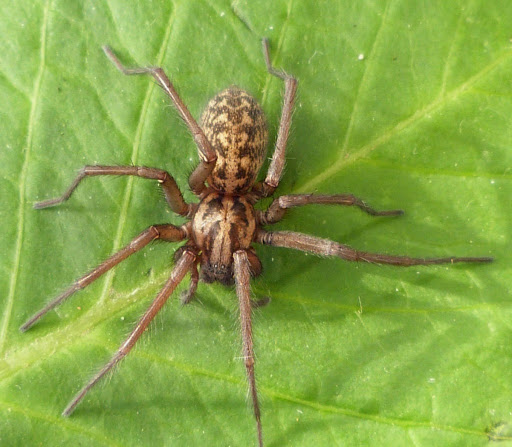
This spider has a light
brown body and legs. The cephalothorax (head united with thorax) has a
darker brown violin-shaped mark on the upper side. The female constructs
an irregular web outdoors and indoors in undisturbed dry locations such as
basements, garages, closets, and farm outbuildings. The web is not usually
used to trap insect prey. Instead, the brown recluse is a hunter, emerging
from its hiding place at night in search of small insects for food.
Favorite hiding places are in seldom-used clothing hanging in dark
closets, in boxes of magazines, papers and other stored items, on the
underside of furniture, in cracks and spaces around baseboards, around
window and door facings, and in dark cellars and garages.
Another good image. Check out this close up of
a brown recluse spider caught on an
"Insect Monitor"
Most victims are bitten after they
put on clothes stored in a secluded closet or that have been
lying on the floor, when cleaning closets or storage areas, or
when they roll on a spider while in bed. Initially, there may be
little or no pain from a brown recluse bite, but over the course
of several hours, an intense localized pain develops, followed by
inflammation of the area. Within a few days, a large ulcerous sore
forms around the bite. This sore heals very slowly and leaves a
large disfiguring scar. There is no specific anti-venom available
for brown recluse toxin, but various other treatments are used to
promote healing. Early diagnosis and treatment are essential to
alleviate pain and speed healing of ulcerated tissue. It can be
important to know what spider caused the spider bite to assist
with an early diagnosis and treatment. Without a specimen, there
is really no way to determine what spider caused a spider bite,
but medical personnel assume that if the bite becomes ulcerous, it
is the bite from a brown recluse spider. If your home is in the
Memphis area don't hesitate to phone us for more information on a
special service for the recluse spider, hobo spider, or any other
pest.
SPIDERS
 |
 |
Black
Widow
photo by M.S. Lacey |
Brown
Recluse
photo by M.S. Lacey |
 |
Hobo
Spider
photo by M.S. Lacey |
COMMON NAME:
Spiders
SCIENTIFIC NAME:
Various
CLASS/ORDER/FAMILY: Arachnida/Araneae/Various
METAMORPHOSIS:
Simple
--------------------------------------------------------------------------------
INTRODUCTION.
There are over 38,000 species of spiders worldwide, with about
3,500 occurring in North America. Many species of spiders are
household pests. Wherever their food is available; spiders are
likely to be found. All spiders are predators, feeding mainly on
insects and other small arthropods. In the United States, three
spider groups are considered medically important: the black widow,
brown recluse, and Hobo spiders.
RECOGNITION.
Non-insect arthropods with 2 body regions, cephalothorax (head and
thorax) and abdomen connected by a tiny waist (pedicel). Antennae
absent. Usually 8 simple eyes, occasionally 6. Below eyes are 2
chelicerae or jaws which end in a hollow fang, connected
internally to poison glands. With 1 pedipalp (palp) between
chelicerae and 1st pair of legs on each side. Legs slender, 4
pairs. Abdomen unsegmented, with a group of fingerlike spinnerets
(produce silk) on posterior or rear end. Males usually smaller
than females and with terminal pedipalp segment greatly swollen,
may also differ in coloration. The immature stages are egg and
spiderlings, the latter closely resemble the adults except for
size and sometimes coloration.
IDENTIFICATION.
Since black widow, brown recluse, and Hobo spiders are of primary
importance in human environments, their identification is
essential. Several different species may be involved and which can
only be identified by experts. However, group recognition alone is
sufficient for the purposes here.
Black
Widow.
Adult female body length about ½" including an almost
spherical abdomen about ¼-3/8" in diameter, with overall
length including legs of about 1 ½ - 1 3/3"; males about
half female size. Color typically black, abdomen on underside with
2 reddish triangular markings usually joined to form a reddish
hourglass-shaped marking but sometimes separated (“split
hourglass”) or only a single mark; usually with red markings
above spinnerets.
Brown
Recluse.
Adults usually about ¼ - ½" in body length. Color tan to
dark brown with a darker fiddle-shaped marking on top of
cephalothroax whose neck points towards abdomen. Uniquely, with 6
eyes arranged in 3 groups of 2 (diads) in a semicircle. Found
primarily in southern states.
Hobo
Spider.
Adult female body length about 7/16 - 5/8" including oblong
abdomen, male body length about slightly smaller. Total size
including legs about 1-1 ¾" in diameter. Color variable with
carapace (top of cephalothorax) light to medium brown, with dark
stripe to either side of lighter midline stripe, dark stripe with
lateral extensions in posterior half; abdomen with interrupted
light midline stripe with about 5 light colored triangular shaped
loops on each side bordered by a dark background. Last 2 or 3
loops chevron-shaped. Found only in the northwest United States.
BIOLOGY.
After mating, females produce egg sacs. Depending on the species,
one or more sacs may be made. Early instars (spiderlings) spin a
silk thread into the air and float out on the breeze like kites.
This is called ballooning and provides for general dispersal of
the species. Spiderlings go through 4 - 12 molts before maturity.
Most spiders live for 1 to 2 years. Spiders are predators,
paralyzing or killing their pry with venom. They typically feed by
injecting a predigestive fluid into the body of their pry and then
suck in the digested liquid food. Spiders can survive without food
for several weeks to a few months. Most spiders are nocturnal and
hunt or capture prey primarily at night. During the day, they hide
and remain inactive in cracks and crevices. Spiders rarely bite
people and only do so as a means of defense.
CONTROL.
Spider control is a multi-step process.
-
Inspection.
A thorough inspection of the building is essential and many
have to be made at night because most spiders are nocturnal.
-
Identification.
Accurate identification is important for both pest management
and medical reasons.
-
Prevention.
This consists of making sure that the building is in good
physical condition, and properly screened and sealed to reduce
entry. Also, changing the lighting to off-building locations,
from mercury vapor to sodium vapor lamps, or in the case of
homes, changing the bulbs near the entrances to yellow bulbs,
may be of help in reducing attractiveness to insects and hence
spiders.
-
Sanitation.
Such practices consist of keeping the premises free of debris
such as boxes, papers, clothing, lumber piles, etc; it is wise
to wear protective gloves and clothing when cleaning out such
accumulations of clutter. A thorough housekeeping should be
done twice each year. Outside, remove debris, firewood and
lumber piles, landscape timbers, stones, etc. Keep the grass
mowed to 3” or less and trim back any vegetation in contact
with the structure.
-
Mechanical
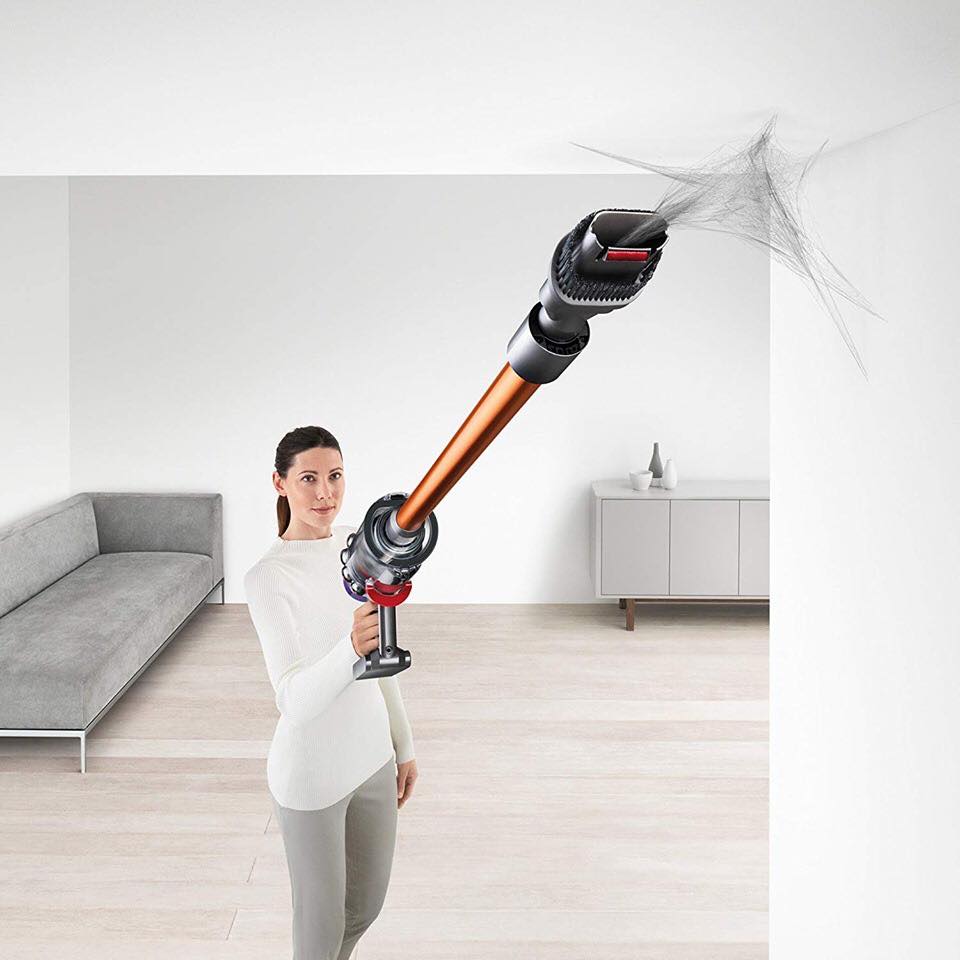
measures. The key to control is the timely mechanical removal
of spiders and webs, but especially the egg sacs with a
vacuum, both inside and outside; seal and dispose of the bag
immediately. If a broom is used for the removal, then it is
suggested that if a spider is present on the web that an
appropriately labeled insecticide be used for a quick contact
kill before removal of the web.
-
Pesticide
application. If desired, chemical control consists of the
application of appropriately labeled dusts, wettable powders,
microencapsulated, or lacquer pesticides in typical spider
harborages. Perimeter treatments are helpful. If web-building
spiders are the problem, lightly dusting the web with a
non-repellent dust is very effective. Control of spider insect
food is desirable but will only help in long term as spiders
can go for weeks or months without food.
The insect traps (monitors) is a great tool for this task and a simple
procedure for the homeowner. However, you do not want to substitute this
as your only approach if you have a serious infestation.
You may also need a Liquid
Spider Spray to enhance your control measures
|