carpenter bees, bees, wasp control, yellowjackets, yellow jackets

bee, honey bee, honey bees, bees
Courtesy of Durham's Bee Farm

  View Cart   /   Home   Products On Sale

Bees & Wasp / Facts & Control


 Carpenter Bees

INTRODUCTION, Carpenter bees get their common names from their habit of boring into wood to make galleries for the rearing of young.

courtesy of npma
  • RECOGNITION, Adult body length about 1/2 to 1", robust in form, resembling bumble bees.The male has a yellow face but with top surface of abdomen largely bare and shining and black in color. The eastern carpenter bee has a range that extends westward to Kansas and Texas.
  • BIOLOGY, Carpenter bees are not social insects and do not live in nests or colonies. The adults hibernate, typically in abandoned nest tunnels. In the spring, the survivors emerge and feed on nectar Then mating begins and extends into nest-construction time. The mated female may either reuse an old gallery, construct a new one by lengthening an old gallery, bore an entire new one, or extend a gallery from a common entrance hole. The female typically bores a circular hole (same diameter as her body) straight into the wood across the wood grain for a distance equal to her body length. Then the gallery takes a right-angle turn, usually with the grain of the wood and parallel to the outer longitudinal surfaces. New galleries average 4-6" long but galleries developed/used by several bees may extend up to ten feet.
  • The female provisions each gallery cell starting at the closed end of the gallery with a mass of pollen and regurgitated nectar upon which she lays a single egg. This portion of the gallery is then sealed off with a chewed wood-pulp plug, making a chamber or cell. This process is repeated until a linear series of 5-6 cells is completed, about one cell per day. Developmental time (egg to adult) for the eastern carpenter bee is about 36 days.
  • Male carpenter bees tend to be territorial and often become aggressive when humans approach, sometimes hovering a short distance in front of the face or buzzing one's head. Since males have no stinger, these action are merely show. However, the female does have a potent sting which is rarely used.
  • CONTROL, Carpenter bee control consist of Trapping or treating each individual gallery (one at a time) with ECOPCO Dust or VIPER Insecticide Concentrate .


 Honey Bees

Courtesy of Durham's Bee Farm
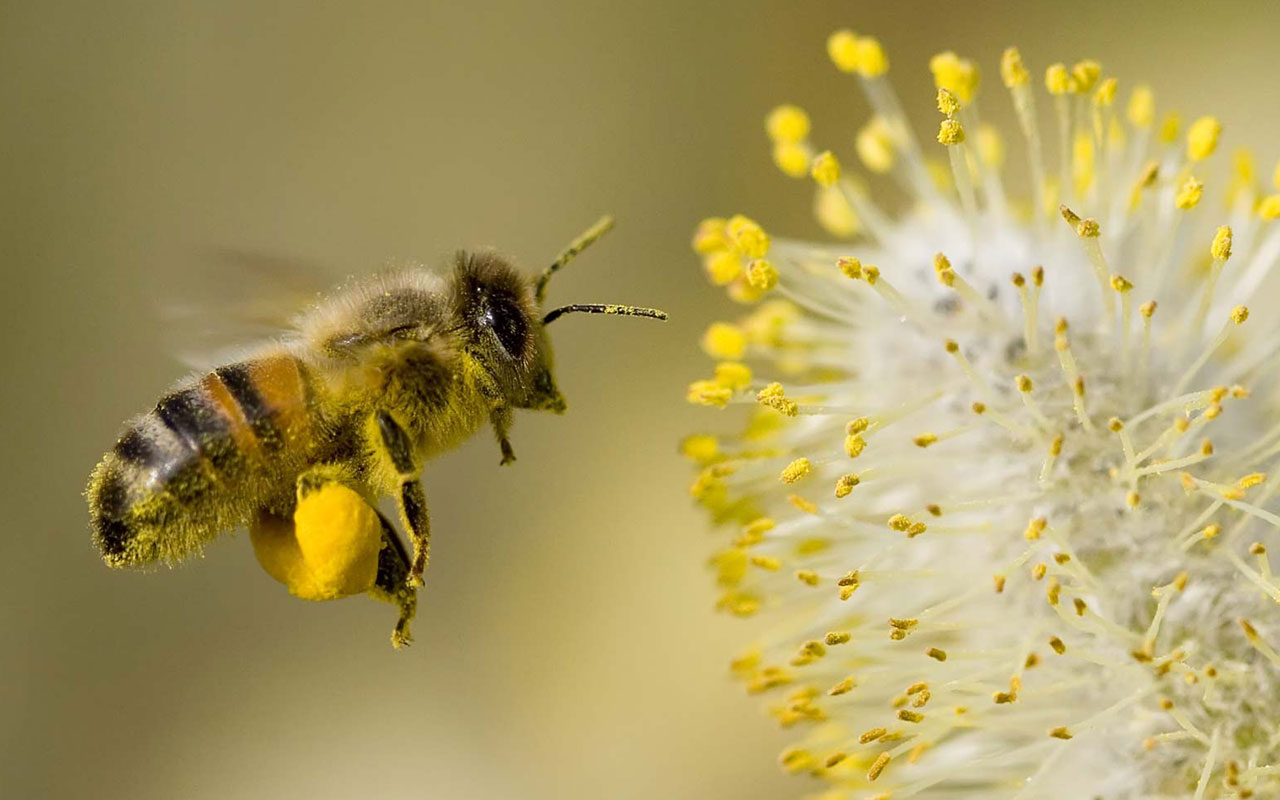
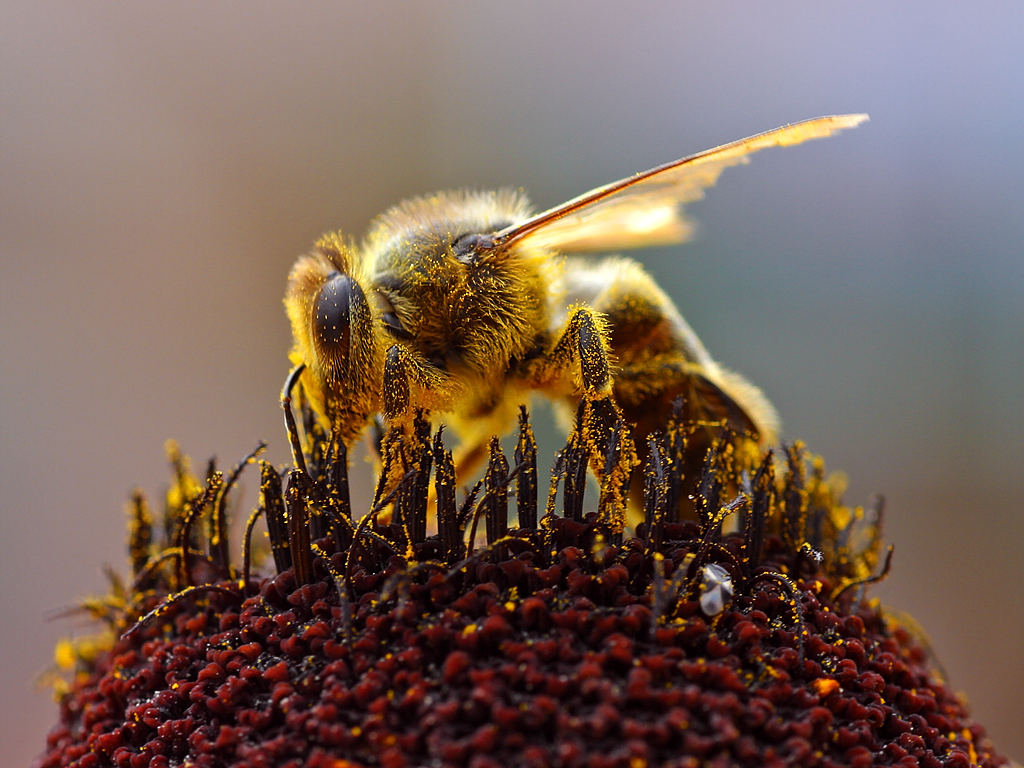
  • Honey bees may become troublesome when they swarm or build colonies in or near residential areas Honeybees occasionally invade homes and establish a colony, building combs of wax containing honey, pollen and brood in wall spaces.
  • Once established, a colony is difficult to remove because it usually involves structural modification of the building. To be effective, the honey and wax should be removed along with the bees or the site will remain attractive to other swarms.
  • In addition, ants, carpet beetles, flies and cockroaches may find their way to the comb to feed and reproduce. Several methods may be used to control honey bees once they are established in a building, but prevention is the best way to avoid the problem. Good maintenance, including painting, repairing or replacing rotted boards or broken brick and caulking, can prevent a colony from getting started.
  • If a colony becomes established, call a local beekeeper who may be interested in removing the colony. Names of beekeepers can be obtained through your local extension office or the State Agriculture dept, Bureau of Plant Industry.


 ("Killer") Bees


AFRICANIZED ("KILLER") BEES 
Apis mellifera scutellata
Africanized ("Killer") Bees can be found in AZ, CA, NM, NV, TX

Color: Golden-yellow with darker bands of brown. 
Legs: Six 
Shape: Oval; bee shape 
Size: 1/2 inch 
Antennae: Yes 
Flight: Yes

Africanized "killer" bees looks so much like a regular honeybee that the only way to tell the two apart is by measuring their bodies. Africanized bees have different wing measurements than honeybees.

Habits
These bees defend their colony and attack when threatened.

Habitat
Africanized bees have small colonies, so they can build nests in unique places. They have been known to live in tires, crates, boxes, and empty cars.

Threats
Their venom is no more dangerous than regular honeybees-they just tend to attack in greater numbers, which causes more danger to humans. 

Prevention
Because of the aggressive nature of these pests and the enormity of their nests, a pest control professional or beekeeper may be needed to address serious infestations. If you are chased by Africanized honeybees, run in a zig zag pattern and seek shelter in a house or car.


  • If the bees must be destroyed, apply an insecticide dust ECOPCO DUST or 
    P.I. Contact Insecticide
    in the evening 
    when bees have returned to the colony and temperatures are cooler.
  • In many cases, it is to difficult for the homeowner to contact combs directly with the insecticide, since they often are some distance from the actual point of entry into the building. In those cases an experienced beekeeper or pest control operator may be more suited for the task or the new Honey Bee Trap maybe your answer. The size and scope of your infestation will depend upon the correct approach.
  • CAUTION: You should never use honey or wax from honey bee colonies that have been treated with an insecticide. Also, never attempt to kill bees in buildings with liquid petroleum, gasoline, or any other flammable material. The entire structure may be destroyed along with the bees! (Courtesy of Nebraska Univ.)

For the best Honey Bee Pollen, Jelly and etc. on the planet 
Go Here http://www.beepollen4u.com/ ask for Mr. Durham.


 Bumble Bees

                       "Image(s) Courtesy of Univar USA Inc"

COMMON NAME:

Bumble bees

SCIENTIFIC NAME:

Bombus spp., Psithyrus spp.

CLASS/ORDER/FAMILY:

Insecta/Hymenoptera/Apidae

METAMORPHOSIS:

Complete

  • INTRODUCTION. The common name of bumble bee possibly comes from their rather large, clumsy appearance and/or the buzzing sound they make as they fly. In the urban setting, bumble bees do not usually nest in structures but are of concern because of their abundance around the many flowering plants typical of yards, and because they can sting. There are about 51 species (45 in Bombus, 6 in Psithyrus) in the United States and Canada, and as a group they are found throughout the United States.
  • RECOGNITION. Adult worker body length about 1/4-1" (6-25 mm), queens about 3/4-1" (17-25 mm) long; robust in form. Color black with yellow (rarely orange) markings; with overall fuzzy appearance, including top surface of abdomen. Head with distinct space between base of compound eye and base of mandible. Hind tibia with apical spurs. Front wing with 2nd submarginal cell more or less rectangular, about as long as 1st submarginal cell. Hind wing lacks a jugal lobe (lobe on rear margin near body). Stinger relatively smooth, with small barbs. In addition, Bombus with hind tibia modified into pollen basket (surface bare and polished, marginal hair fringe) whereas, Psithyrus lacks pollen basket, hind tibia slender.
  • SIMILAR GROUPS. (1) Carpenter bees (Xylocopa spp.) with top surface of abdomen largely bare and shining, front wing with 2nd submarginal cell triangular, and hind wing with jugal lobe (lobe on rear margin near body). (2) Some robber flies (Diptera: Asilidae) with only 1 pair of wings. (3) Some hawk moths (Lepidoptera: Sphingidae) with siphoning mouthparts.
  • BIOLOGY. Bumble bees are social insects which live in nests or colonies. The adults are represented by workers (Psithyrus spp. lack workers) which are sterile females, queens, and males (drones) which come from unfertilized eggs and usually appear in late summer.
  • Typically, only inseminated queens overwinter and do so underground. In the spring, the queens of Psithyrus species wait until the Bombus nests are moderate in size and then parasitize them. The Bombus queens select a suitable subterranean cavity or surface grass clump as a nesting site. Then the Bombus queen fashions a honey pot of wax scales near the nest entrance into which she regurgitates nectar. Next she makes a pollen clump on the nest floor and lays 8-10 eggs on it. The queen will periodically add pollen and nectar to the peripheral edges of the clump, and eventually more eggs. Developmental time (egg to adult) is 16-25 days, with 4 larval molts. Workers live about 2 weeks. Most first brood workers are small due to nutrition. The queen will increase the number of eggs laid as the number of workers to care for them increases.
  • During the summer, parasitism may eliminate up to 50% of the colony's workers each week. However, a mature bumble bee nest ultimately contains about 50-400 bees at any given time; the largest known nest contained 756 bees and 385 brood (larvae and pupae).
  • The nest temperature is regulated to about 86 degrees F (30 degrees C). This thermoregulation is accomplished by the bee relaxing the 3rd axillary muscle to its wings which unhinges the wings from the main power-producing thoracic muscles. Then contractions of these large muscles produces body heat without wing movement.
  • In the late summer only males (drones) and new queens are reared in the nest. Once these new queens emerge, they mate and find a suitable place to overwinter.. The males, workers, old queen, and any virgin new queens die with the onset of cold weather.
  • HABITS. Depending on the Bombus species, the overwintering queen will select an appropriate nesting site the following spring. The queen of some Bombus species locate a dark cavity at least 3/4" (2 cm) high by 1 1/8" (3 cm) wide containing fine plant fiber; such a nest is usually underground and often an abandoned mouse nest. Queens of other Bombus species select a dense clump of grass on the surface for a nest, adding grass on top. The queens of Psithyrus species are all parasitic on Bombus nests, so they bide their time until the Bombus nests are moderate in size and can therefore support them. They then enter the nest, kill the Bombus queen, and take over the nest using the Bombus workers to care for her young. Bombus queens of later emerging Bombus species sometimes also parasitize the nests of earlier emerging Bombus species.
  • Bumble bees foraging for nectar fly at 7-12 mph (11-20 km/hr) and spend only 2-4 minutes inside the nest between trips. Probably they will travel at least 3 mi (5 km) if necessary for nectar. They orientate by the sky's polarized light via their 3 ocelli, so they can forage before and after light when objects and landmarks are not visible. They use their thermoregulation procedure to warm up flight muscles before the sun rises and to also forage when temperatures are below 50 degrees F (10 degrees C; lowest observed flight at 26 degrees F/-3.6 degrees C) whereas, most bees stop foraging at 61 degrees F (16 degrees C). Each worker forages independently, and bumble bees never exchange food. Old cocoons are used to store both pollen and nectar. Only enough food (honey and pollen) for a few days is stored at any given time which helps discourage nest predation by skunks, foxes, etc.
  • Defense is usually done by using their relatively smooth stingers which can be used over and over. Some species will also spray feces, and some cover the intruder with regurgitated honey. People sensitive to insect venom should exercise care around bumble bee nests.
  • CONTROL. Bumble bees are considered beneficial insects because they pollinate the flowers of many plant species. However, if their nest is located in or close to an occupied structure or recreational area, then control is warranted. During the day find the location of each nest by observing where the bees disappear into the ground, grass clump, or structure. At night using background light and while wearing a Bee Bonnet, apply an appropriately labeled pesticide . Dusts work best ECOPCO Dust when applied to an area 6" (15 cm) around the nest entrance. For structural nests, treat with dust or aerosol EcoPCO® JET•X – Wasp & Hornet Jet Aerosol but do not seal the entrance. Structural nests should be either retreated with a long-lasting repellent material and sealed or the void opened up and cleaned out within 1-2 days to prevent future problems with dermestid beetles, spider beetles, and/or psocids. (Courtesy of NPMA)


 Paper or Umbrella Wasps


(Courtesy of Nebraska Univ.)

  • Paper wasps are about 1" in length, have a spindle-shaped body and are marked with a brown and yellow pattern. Paper wasps construct umbrella-shaped, single-layered nests with exposed cells. Nests may be built in trees and shrubs but frequently are found under building overhangs, in attics, barns, garages and sheds.
  • Nests are initiated in the spring by a single overwintered queen called the foundress. Other fertile females often join the colony later in the season. Colonies may produce up to 200 individuals by summer's end. These wasps are not considered overly aggressive and usually pose a threat only when their nests are disturbed. However, foraging wasps can cause considerable annoyance as they fly in and about entrances of buildings. 
  • The best approach for controlling paper wasps involves treating nests with liquid VIPER Insecticide Concentrate or aerosol jet insecticide sprays after dark. Knocking down a nest without an insecticide treatment usually is ineffective since these wasps will rebuild the nest in a short time.
  • When wasps are active in attics, barns, boat houses, garages and sheds. Insect Guard (vapor strips) are perfect for controlling their nest building. 
 Yellowjackets

yellow jackets, yellowjackets, yellowjacket, yellowjacket
(Courtesy of Nebraska Univ.)

  • Yellowjackets feed on insects, spiders and a wide variety of other food items. They are medium-sized, stout-bodied, and black with bright yellow bands. Yellow-jackets construct globular paper nests, usually in underground cavities. Favorite nesting times include rodent burrows, compost piles and wall voids.
  • Occasionally these wasps build aerial nests in garages, crawl spaces or other enclosed areas. Nests are built of paper made by stripping wood fibers from trees, fences, garden stakes and other wooden structures. The combs are built in tiers and are surrounded by an outer paper covering.
  • When yellowjackets are disturbed, give them plenty of room since they are capable of inflicting painful, multiple stings. If yellowjackets become excited and appear about to attack, do not panic. Make no sudden movements and retreat slowly and calmly from the area.
  • Yellowjackets are scavengers and frequently are found foraging around compost piles and garbage receptacles. Their activity can be discouraged in the vicinity of patios, parks, picnic and other recreational areas by covering all food and disposing of waste in covered containers.
  • Turning compost piles regularly and placing insecticide-impregnated resin strips in the lids of garbage cans and dumpsters will help reduce the numbers of yellow-jackets in these areas. Yellowjackets are highly attracted to overripe fruit. Prompt removal of fallen fruit should help reduce the attractiveness.

Insecticide bait station

  • One strategy used by professional pest control operators to reduce the number of yellowjackets in an area involves the use of bait station traps . Bait stations are hung in sunny locations around the periphery of the area to be protected. The use of this technique dictates that special precautions be taken to ensure that the bait stations are not accessible to children, pets, wildlife, or uninformed individuals. Control strategies for yellowjacket colonies depend on the location of the nests.
  • Aerial nests: From a safe distance and after dark, treat the nest with liquid or EcoPCO® JET•X – Wasp & Hornet Jet Aerosol  Remove the nest a day or two after treatment. 
  • Ground nests: Treat the nest with dust or liquid insecticide formulations after dark. Approach the nest very carefully, since a number of yellowjackets typically will be guarding its entrance. Apply the insecticide, then quickly seal the nest opening with a shovel full of dirt, a sheet of plywood or a flat rock. Insecticide dust formulations generally are preferred because workers attempting to use the nest opening will track dust and contaminate brood and other colony members. Retreatment may be necessary after a few days if yellowjacket activity continues.
  • Nests within cavities: Yellowjackets occasionally build their nests in wall voids, cracks in stone walls or other cavities associated with buildings. In such cases, do not seal the entrance hole following the insecticide treatment because yellowjackets attempting to leave the nest may enter the building through inside openings. Insecticide dust formulations are preferred since the workers entering or leaving the nest will tend to be contaminated. (Courtesy of Nebraska Univ.)
 Cicada Killers

(Courtesy of Nebraska Univ.)
  • This is the largest wasp species . They are up to two inches long and are boldly marked with yellow stripes on a black body. Cicada killers are most abundant during midsummer when their prey, the cicada, is active.
  • Cicada killers attack, sting and carry paralyzed cicadas back to underground burrows. These burrows can be found near walks, driveways and retaining walls and usually can be identified by the presence of fresh soil around the 1/2-inch entrance hole. Once the paralyzed cicada has been dragged underground, the wasp deposits an egg on it. Upon hatching, the wasp larva uses the cicada as a source of food.
  • These wasps normally are very docile and are unlikely to sting unless provoked. However, if nesting activities become a problem, infested areas can be treated with an insecticide dust  or granules


 Mud Daubers
  • Mud Daubers are medium-size (1-1.5 inches) wasps with the front portion of the abdomen long and highly constricted, giving them a "thread-waisted" appearance. These wasps range in color from metallic blue to black. They feed almost exclusively on spiders. These wasps do not defend their nests and are not likely to attack people.
  • Mud dauber nests are constructed of mud or clay and often are found attached to the walls or under the eves of buildings. When emergence holes are present in nests, the wasps have completed their life cycle and no longer are present. These nests should be removed by scrapping with putty knife and discarded or use these products:  cobweb and mud nest preventer. to prevent re-formation.  
  • Nests without holes can be removed and crushed or treated with an insecticide, EcoPCO® JET•X – Wasp & Hornet Jet Aerosol . The destruction of nests discourages infestations by dermestid beetles and other insect scavengers which could move to other household items. If the problem is in a non-living area like sheds or attics. Vapor Strips will keep them in check.


 Digger Wasps
Digger wasps are beneficial. They appear in the morning and fly-over turf in search of beetle grubs or the larvae of other insects. These wasps generally do not sting unless handled or molested. If this kind of wasp control is desired, treat the lawn with a liquid VIPER Insecticide Concentrate or granular insecticide . Such treatments for wasp control also will reduce turf insect populations and, therefore, foraging by digger wasps.


(Other Pests Problems)   (Contact us)   ( Warranties/Return Policy)   (Privacy Policy)   (Back to top


For Customer Service Dial 1.901.365.2847
For Orders Dial Toll Free 1.877.800.6884
Pest Control Solutions 
2938 Ridgeway 
Memphis, TN. 38115
© 2002 - 2010 PestControl-Products.com